


Locate containers, view condition reports, and manage rental...
👀 3144 views
❤️ 345 likes
Too Long;
Didn't Read
38% faster decision-making and 45% less manual tracking. Here is how the Katana dashboard got there:
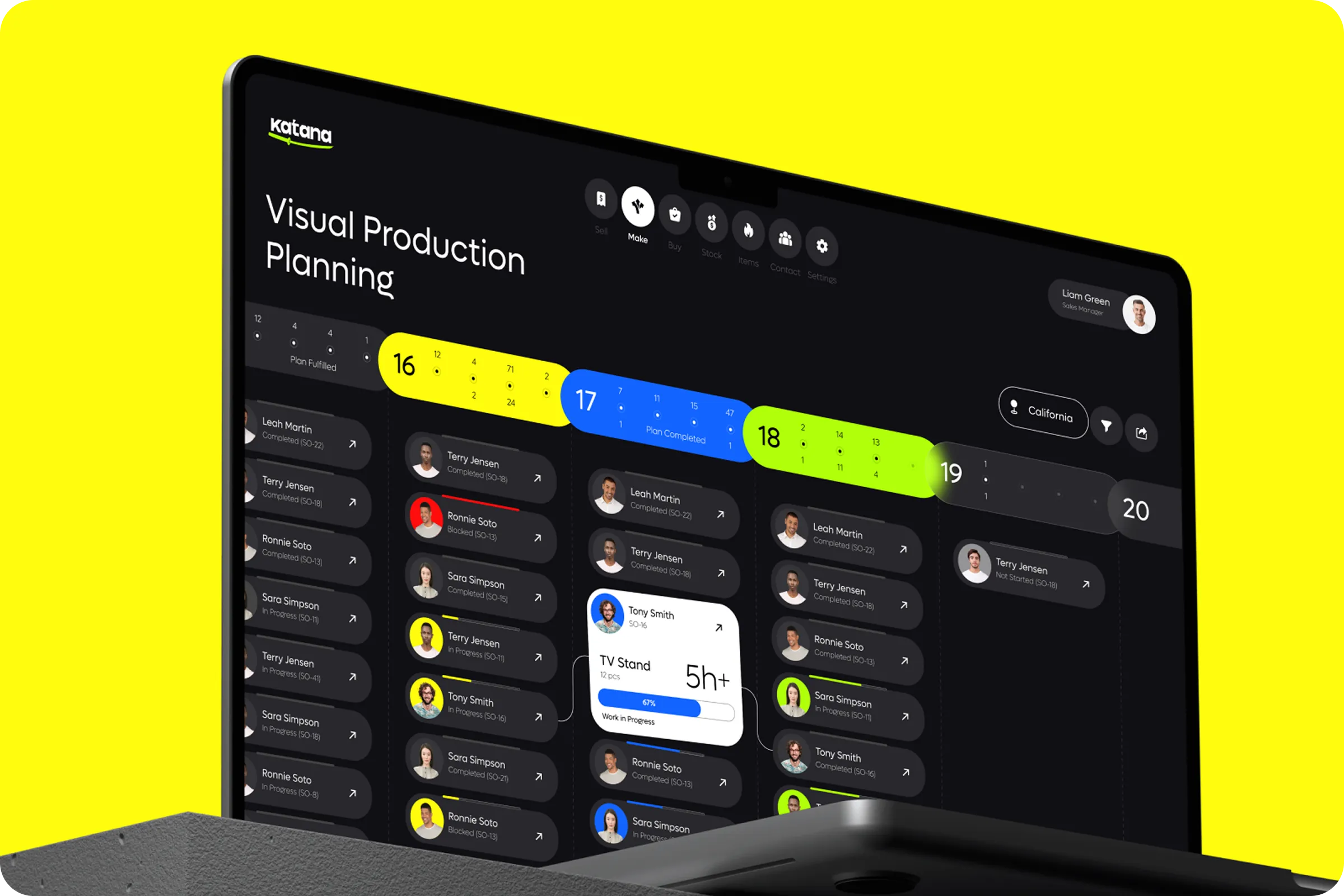
We need a web dashboard that centralizes production, inventory, and order tracking, giving teams real-time visibility to boost efficiency and cut operational bottlenecks.

CPO at Katana

Katana MRP is a cloud platform that helps small and mid-sized manufacturers plan production, manage inventory, and track orders in one place. This project designed its production management web dashboard, the screen that tells a shop floor what to make next and whether the materials are there to make it. Smaller manufacturers rarely have a planning department. The owner, a production lead, and someone in purchasing share the job, often across spreadsheets, email, and a whiteboard by the machines. A manufacturing resource planning system only helps them if it is faster than those habits. Our brief was to bring inventory, order tracking, and scheduling into one dashboard that reads at a glance and updates in real time. Each screen had to answer a practical question: what is late, what is short, and what should move first. That focus shaped every widget, alert, and navigation path in the final design.
Industry
MRP, Management
Category
Web Design, SaaS, Dashboard
Location
San Diego, USA

Manufacturing teams worked across scattered tools. Orders lived in one system, stock counts in another, and the production schedule often in a spreadsheet only one person fully understood.
Real-time coordination broke down as a result. Material planning happened after the fact, when a shortage had already stopped a job. Each gap between tools added delay, and each manual handoff added the risk of an expensive mistake. For a small manufacturer, one missed component can push back an entire week of orders and pull the whole mrp supply chain out of sync.
Our focus was simplifying complex processes into one intuitive interface to reduce operational friction.

CIO

We grounded the design in ux research: workshops with product managers, engineers, and machine operators, each describing the same week from a different seat. Two needs came up in every session. Users wanted data they could trust in the moment, and they wanted to see how one workflow affects the next. Those two needs became the test for every screen in the mrp system software.
72% reported data delays
Production updates often reached users late. Bottlenecks formed, schedules drifted, and teams found out after the fact, the core failure of a slow material planning system.
58% relied on manual tracking
Many users tracked inventory and orders by hand because the automated system was unreliable. Error rates and workload rose together, and confidence in the material requirement planning system fell with them.

We managed to make a great product and enjoy the process. The collaborative teamwork, attention to detail, and passion we infused into the project contributed to our overall success and deepened our sense of fulfillment.
Company type
Project type
Result
We rebuilt the dashboard around clarity and action. A clean, predictable layout puts the most urgent information first, so mrp planning starts from what needs attention today rather than a wall of data. Transparency improved, and errors dropped.
Centralized Workflow Hub
A modular dashboard combines inventory, orders, and production planning in one place. Users switch between tasks without leaving the screen, and material resource planning mrp data stays in step with the schedule.
Interactive Visual Indicators
Color cues and alerts flag shortages, delays, and blocked orders the moment they appear. Teams set priorities in seconds instead of digging through reports.

The final dashboard gave teams real-time visibility and tighter control over operations. Delays shrank and productivity rose across the full production cycle. For small and mid-sized makers, replacing spreadsheet coordination with live manufacturing resource planning is a practical digital transformation, and one that shows up on the shop floor within days, not quarters.
+38% faster decision-making
Centralized data and real-time updates let teams respond faster and cut delays in production adjustments.
-45% reduction in manual tracking
Automated inventory and order management reduced reliance on error-prone manual work. This is where mrp software for manufacturing proves its value: accuracy improves and hours come back to the team.

The design simplified complex processes. The dashboard’s clarity and speed improved planning and issue resolution, helping us meet growing demand more effectively.
CPO at Katana
Locate containers, view condition reports, and manage rental...
👀 3144 views
❤️ 345 likes
Organize athlete training, match data, and performance tracking....
👀 3173 views
❤️ 320 likes
The SailMatch - Yacht Personalized Searching Service Onboarding...
👀 3176 views
❤️ 343 likes
Explore the Moody e-commerce case study. See how...
👀 1632 views
❤️ 362 likes
Shall we chat?
[email protected]Let’s

talk


